What is a Potentionmeter?
The word potentiometer comes from potential, which is what a potentiometer regulates. A potentiometer manages the potential, or amount of current, allowed through a circuit. Essentially, it is a variable resistor that slows down the amount of electricity that flows through it. Think of a potentiometer as the electrical equivalent of a water valve, both regulate the current passing through them.
"Think of a potentiometer as the electrical equivalent of a water valve, both regulate the current passing through them."
How Does A Potentiometer Work?
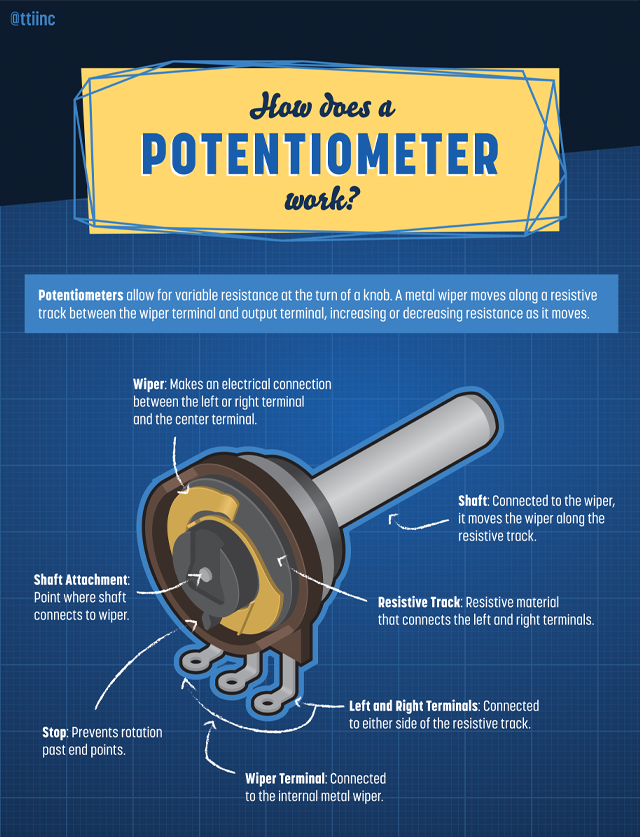
A potentiometer has a simple operation. It basically consists of a variable resistor, which changes its value as the current increases. This resistor has three terminals to which the voltage to be measured is connected. There’s one at each end with a third connection to a slider. This control will allow an increase or decrease in resistance. The value between the connections varies by turning the moving part of the potentiometer.
Applications of Potentiometers
Potentiometers are versatile gadgets that can be used for many output regulating purposes. The most common use for a pot is in audio control, however, they are also used in televisions, motion controls, position transducers, computation, and many other equipment control applications.
Another common use for potentiometers is in automobiles. The potentiometers read the setting of the gas pedal during acceleration, and the transfer of power is then pulsed to the motor from the battery through the controller to regulate the speed of the car. They are also used to regulate the automobile’s windshield wiper and blinker output.
Types of Potentiometers
Potentiometers are either mechanical or digital. Mechanical potentiometers are made up of linear potentiometers and rotary potentiometers. The linear potentiometers have a sliding mechanism while the rotary potentiometers have a rotational mechanism. A digital potentiometer has the same function as a normal potentiometer but instead of mechanical action it uses digital signals and switches.
This means that all potentiometers classify into three main categories: linear potentiometer, rotary potentiometer, and digital potentiometer. All three fit specific needs. Rotary potentiometers are the most common of the three. Here is an in-depth breakdown of specific types of potentiometers.
"Potentiometers classify into three main categories: linear potentiometer, rotary potentiometer, and digital potentiometer. All three fit specific needs. Rotary potentiometers are the most common of the three."
Rotary Potentiometers
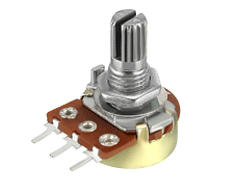
Single-Turn Potentiometer
Single-turn potentiometers can only be rotated to one position (approximately 270 degrees or ¾ of a full turn). A single-turn potentiometer is mostly used in applications where a single turn can provide enough control resolution. This potentiometer is usually used in volume control where you don’t need several turns to get an exact volume.
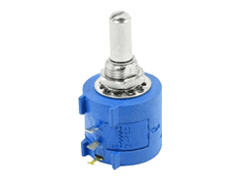
Multi-Turn Potentiometer
Multi-turn potentiometers are designed with a wiper that is driven on a spiral or helical form, or by using a worm gear. Usually, these potentiometers have multiple numbers of rotations like 5, 10, or 20 for increased precision. These potentiometers are mostly used in applications like trim potentiometers on the printed circuit boards (PCB), which require high precision and resolution.
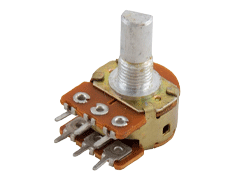
Dual-Gang Potentiometer
Dual-gang potentiometers are designed by placing two potentiometers together on the same shaft. The Single Turn potentiometers with equal resistance and taper are mostly preferred for the combination. Although we can add more than two potentiometers in the gangs, it is not very common to do so. These are commonly used in stereo audio volume control and other applications where two channels must be adjusted at the same time.
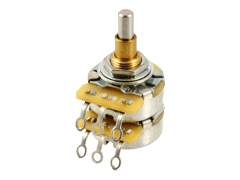
Concentric Potentiometer
Concentric potentiometers give you two controls in the space of one. This allows the user to have two controls on the same unit varying two different resistances. These potentiometers are mostly used in car radios where the volume and tone control are placed together.
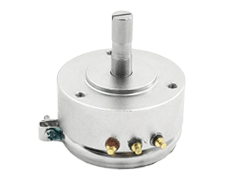
Servo Potentiometer
Servo potentiometers have a servo motor attached to the pot. The wiper can be controlled automatically by driving the motor. This type of potentiometer uses an application that requires both manual and automatic adjustments, mostly in audio equipment where remote control can turn the volume control knob.
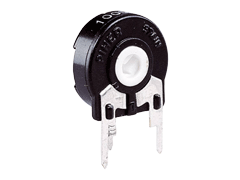
Pre-sets and Trimmers
A trimmer potentiometer, also known as a trim pot, is a type of variable resistor or adjustable potentiometer that can adjust, tune, and calibrate circuits. These trimmer resistors are often used to initially calibrate equipment after manufacturing.
Linear Potentiometers
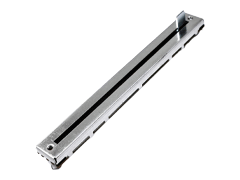
Slide Potentiometer
A slide potentiometer is a single linear slider potentiometer which is also called the fader. The fader is constructed with conductive plastic. These are mostly used for audio applications and single-channel control or for the measurement of distance.
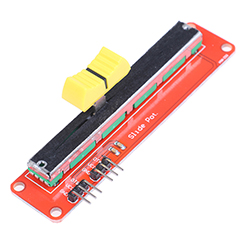
Dual Slide Potentiometer
Dual slide potentiometer consists of a single slider that can be used to control two potentiometers in parallel. They are often used for stereo control in professional audio and other applications where dual parallel channels are controlled.
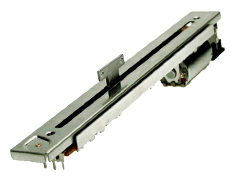
Motorized Fader
This is a type of fader that can be automatically controlled by a servo motor. These faders are used in applications that require both manual and automatic adjustment. Mostly used in-studio audio mixers, the servo fader is used to automatically move to a saved configuration.
Digital Potentiometers
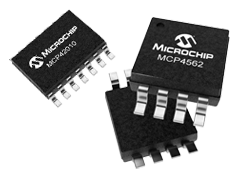
Digital potentiometers (or digiPOTS) have many advantages over the typical mechanical potentiometers. They are significantly smaller, they do not move with age or vibration, and they can be recalibrated remotely. They also don’t have to endure the issues mechanical potentiometers run into like wiper contamination, mechanical wear, resistance drift, sensitivity to vibration, humidity, etc.
Digital potentiometers have various applications, including LED thermal stabilization, LED dimming, closed-loop gain control, audio volume adjustment, calibration, controlling current sources, and tuning programmable analog filters. Digital potentiometers provide the most accurate measurements among the many different types of potentiometers.