Smarter at the Edge: AI-Accelerated MCUs for Industrial IoT
New Tech Tuesdays
Join Mouser's Technical Content team for a weekly look at all things interesting, new, and noteworthy for design engineers.
Published January 27, 2026
Artificial intelligence (AI) is increasingly embedded into industrial systems, yet many deployments still rely on cloud-based inference to extract value from operational data. While effective in some contexts, cloud-centric AI introduces latency, bandwidth costs, and network dependencies that are incompatible with many industrial Internet of Things (IIoT) applications. Systems responsible for safety, reliability, and continuous operation often require decisions to be made in milliseconds, not seconds.
Edge AI addresses these limitations by bringing intelligence directly to embedded devices. By processing data locally, edge-based systems enable real-time decision-making, reduce reliance on connectivity, and keep sensitive operational data on-site.
This week’s New Tech Tuesdays explores how edge AI is becoming a cornerstone technology as industrial systems evolve toward smarter, autonomous operations, and how AI-accelerated microcontrollers can deliver real-time intelligence, predictive maintenance, and enhanced reliability without relying on the cloud.
The Role of AI Accelerators in Embedded Systems
At the heart of edge AI adoption is the integration of AI accelerators into embedded platforms. An AI accelerator is a dedicated hardware block optimized for executing machine learning inference tasks, such as neural network operations. These accelerators offload computationally intensive workloads from the main microcontroller (MCU) core, enabling advanced analytics within resource-constrained environments.
Traditional MCUs are designed for deterministic control and signal processing, not for the parallel math operations required by AI workloads. AI accelerators address this gap by delivering higher throughput and significantly improved energy efficiency compared to CPU-only processing. This efficiency is critical for edge devices that must operate continuously under tight power budgets.
By embedding AI accelerators directly into MCUs, designers can deploy intelligent systems at the edge that respond immediately to local conditions without waiting for round-trip data processing through the cloud.
Enabling Real-Time Intelligence at the Edge
Edge AI unlocks several high-value industrial use cases that depend on immediate insight. One of the most impactful is predictive maintenance. By analyzing vibration, acoustic, or current-sense data in real time, edge-based AI can identify early indicators of bearing deterioration, imbalance, or mechanical degradation before failures occur. This approach minimizes unplanned downtime and reduces lifecycle maintenance costs.
Another use case, anomaly detection, further enhances operational safety by identifying deviations from normal behavior as they happen. Rather than relying on post-processed historical data, edge AI enables systems to respond locally and autonomously. Additional applications include keyword spotting for hands-free control, basic image recognition for quality inspection, and localized security monitoring to detect abnormal access patterns.
The Newest Products for Your Newest Designs®
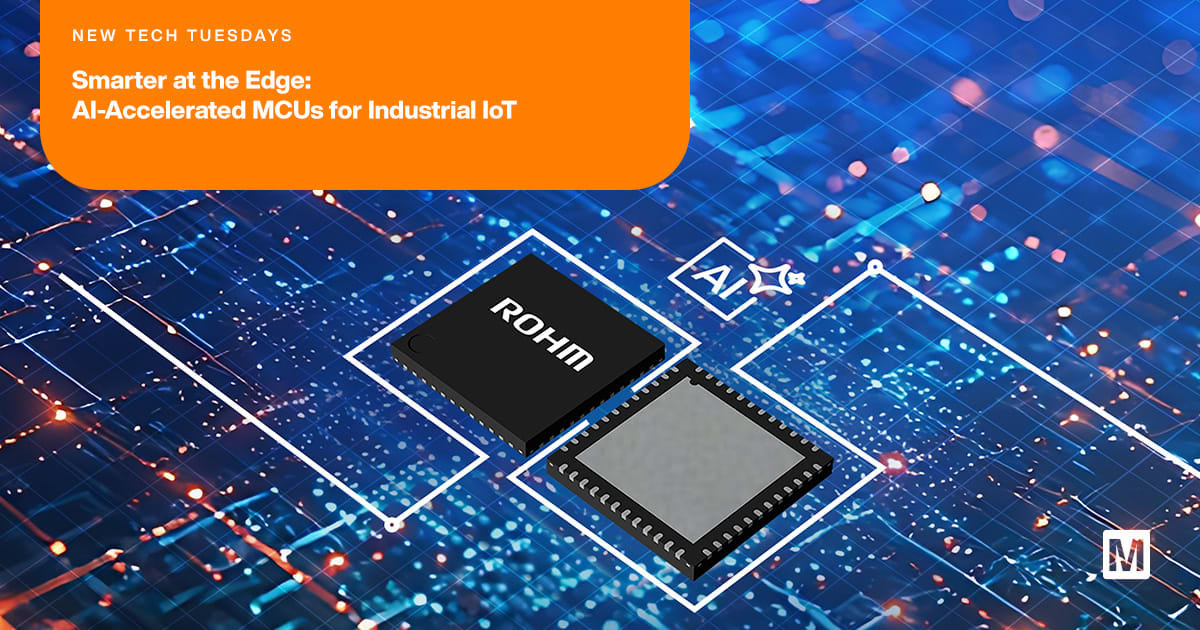
ROHM Semiconductor ML63Q2537 and ML63Q2557 MCUs illustrate how AI acceleration can be effectively integrated into embedded systems. These devices combine an Arm® Cortex®-M0+ core for general-purpose processing with the Solist-AI™ accelerator (AxlCORE-ODL), enabling efficient execution of machine learning inference directly on the MCU.
Peripheral support includes controller area network flexible data-rate (CAN FD) for industrial communication, along with motor control pulse width modulation (PWM) and analog-to-digital converters (ADCs) for sensor-rich applications. ROHM’s proprietary Solist-AI technology further enables on-device anomaly detection and predictive maintenance without requiring cloud connectivity.
Any advanced AI integration must tackle the power management dilemma. These MCUs achieve low-power AI operation at approximately 40mW, making them suitable for always-on monitoring in industrial automation and infrastructure deployments.
Tuesday’s Takeaway
Edge AI is redefining embedded system design by enabling real-time analytics, predictive maintenance, and autonomous operation. With integrated AI accelerators and low-power performance, ROHM’s ML63Q2537 and ML63Q2557 MCUs demonstrate how advanced intelligence can be delivered efficiently at the edge. Shifting processing from the cloud to local brings about efficiency and reliability advantages that will prove invaluable as the IIoT expands with the growth of industrial automation.