Edge AI Is Reshaping HMIs in Industrial Systems
New Tech Tuesdays
Join Mouser's Technical Content team for a weekly look at all things interesting, new, and noteworthy for design engineers.
By Anna Wine, Mouser
Published August 4, 2026
As artificial intelligence (AI) advances, many industrial applications are shifting toward edge or hybrid architectures to reduce constant reliance on cloud infrastructure. Edge AI deploys AI models on local devices rather than relying exclusively on data centers or the cloud, which can improve data privacy and security when paired with appropriate device-level protections. Edge AI can also support lower latency, reduced network bandwidth, increased automation capabilities, and, depending on the architecture, lower overall energy use.[1]
This week’s New Tech Tuesdays explores the evolution of human-machine interfaces (HMIs) amidst the growing role of edge AI in industrial systems. It highlights the core capabilities of HMIs, implementation challenges, real-world applications in manufacturing and logistics, and new technologies that support low-latency processing at the edge.
Understanding Human-Machine Interfaces
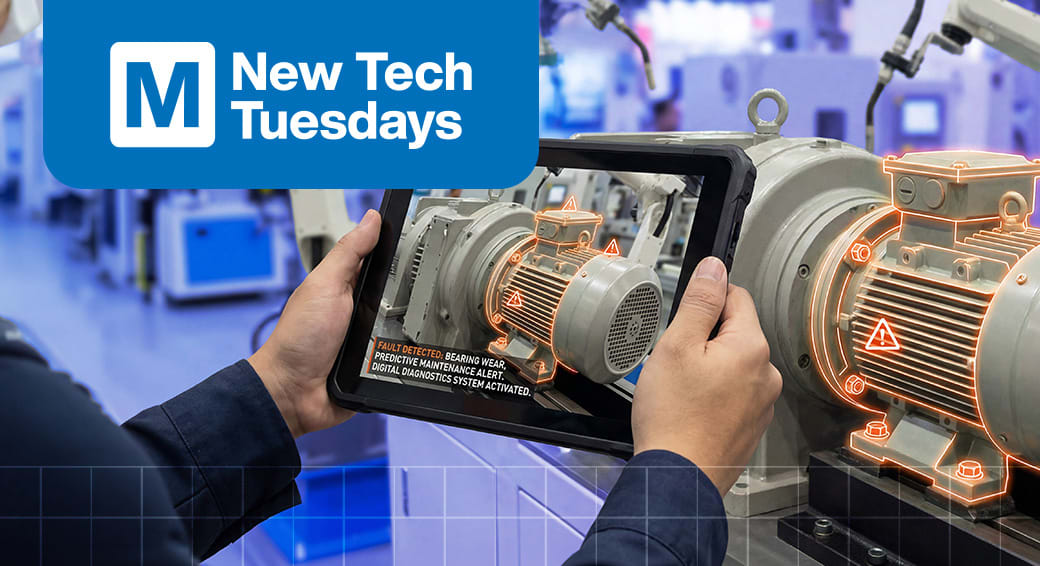
Historically, automated machines were monitored through direct, manual observation, requiring workers to closely watch equipment for signs of defects. Today, HMIs allow users to oversee machine performance at a glance, displaying alerts and diagnostic information so issues can be identified immediately rather than through constant monitoring that still runs the risk of oversight.
In industrial environments, HMIs are often used to monitor machines, track data, and anticipate problems. Centralized data monitoring helps users spend less time on manual checks.[2]
When HMIs incorporate edge computing and AI capabilities, they transition from passive display tools into local decision-making hubs. By processing data locally, edge-integrated HMIs can reduce latency, lower bandwidth requirements, improve data privacy, and support more reliable real-time decision-making. In quality inspection processes, for example, edge-enabled HMI platforms can process or display local AI inspection results, helping detect failures, improve operational efficiency, and enhance automation.[3]
Key Edge AI Implementation Challenges
In industries such as manufacturing, edge AI can assist with vision systems, automated operations, and predictive maintenance. However, companies must have sufficient edge computing infrastructure in place. Engineers must monitor a wide range of operational metrics, including:
- Resource utilization
- System delays and latency
- Energy consumption
- Data privacy protocols
- Model accuracy
The interconnectivity of components, such as Industrial Internet of Things (IIoT) devices, communication links, and end nodes (e.g., cameras), requires each part of the system to be reliable. A malfunctioning component can affect system performance, reduce model accuracy, or interrupt local decision-making unless the system is designed with redundancy or fallback behavior.[4]
In logistics use cases, environmental conditions present unique challenges. Sensors can detect alerts based on temperature, humidity, and shock data monitoring. Still, companies must design, test, and monitor tools based on their specific operational environment to ensure success.[5]
Edge AI in Action: Practical Use Cases
The effects of edge AI, such as improved efficiency and low latency, are invaluable in many industries. Researchers have found that, on average, a large manufacturing plant loses around 253 million USD per year due to unplanned downtime.[6] Predictive maintenance, including edge AI-enabled implementations where local processing is required, can help reduce some downtime-related losses.
In one example, Hitachi Rail adopted an edge platform to process sensor and camera data in real time. The platform is designed to help identify tracks that need repair, monitor overhead power-line degradation, and assess the health of trains and signaling equipment. The railway found that edge AI helped reduce service delays by up to 20 percent, reduce train maintenance costs by up to 15 percent, and reduce fuel costs by up to 40 percent.[7]
In another example, a logistics operator deployed edge AI forklifts to support navigation and collision avoidance in a warehouse.[8] As a result, safety incidents decreased and route efficiency improved. With effective testing and implementation, AI systems can support fleet management while improving accuracy and latency.
The Newest Products for Your Newest Designs®
The NXP FRDM-i.MX 95 development board is designed for AI acceleration and connectivity for edge tools. The board also provides software enablement and use-case demos. Additionally, the board supports HMI systems, vision processing, and industrial networking.

Figure 1: NXP Semiconductors FRDM i.MX 95 development board is based on the powerful i.MX 95 applications processor in a 15mm × 15mm package. (Source: Mouser)
With its Arm® Cortex® -A55 multicore complex, Arm Cortex-M33, Arm Cortex-M7, and eIQ® Neutron neural processing unit (NPU), the FRDM-i.MX 95 board is designed for low-latency processing. In industrial contexts, the board supports automation, visual safety inspection, and real-time monitoring.
Tuesday’s Takeaway
Companies looking to improve efficiency, detect failures earlier, reduce latency, lower bandwidth demand, and improve data privacy should evaluate edge AI where local processing aligns with their operational requirements. When these tools are implemented with edge computing infrastructure and evaluated for success, they can help companies reduce costs, gain efficiency, and stay competitive in the evolving industrial landscape.
Sources
[1]https://www.ibm.com/think/topics/edge-ai
[2]https://inductiveautomation.com/resources/article/what-is-hmi
[3]https://adisra.com/2026/04/10/from-hmi-to-edge-ai-the-future-of-intelligent-industrial-operations/
[4]https://doi.org/10.1016/j.jnca.2025.104375
[5]https://www.n-ix.com/edge-ai-use-cases/
[6]https://assets.new.siemens.com/siemens/assets/api/uuid:1b43afb5-2d07-47f7-9eb7-893fe7d0bc59/TCOD-2024_original.pdf
[7]https://resources.nvidia.com/en-us-industrial-sector-resources/hitachi-rail-igx-real-time
[8]https://www.edn.com/designing-edge-ai-for-industrial-applications/