Advancing Safer, Smarter Air Mobility
 Source: Julia Jones/stock.adobe.com; generated with AI
As uncrewed aerial vehicles (UAVs, also known as uncrewed aircraft systems, or UASs) expand across industries, critical conversations are needed to define the laws, policies, and infrastructure that will ensure safe operation and broad societal benefit.
Dan Sloat, professor of Advanced Air Mobility at the University of Arkansas and the founder of the Advanced Air Mobility Institute (AAM Institute), is at the center of these conversations. Through his nonprofit, Dan is working closely with decision-makers in various communities to promote safety, dignity, and resilience as these systems roll out.
We recently caught up with Dan to discuss his work on advanced air mobility issues and the best path forward for addressing the biggest challenges shaping the future of air mobility.
Mouser Electronics: You’ve worked in the military, law, aviation, emergency response, and policy. What first drew you into the UAS world—and what’s kept you invested in it?
Dan Sloat: While serving as a captain in the United States Air Force … I coordinated drone operations across all US military branches and our allies. That experience showed me how powerful these systems could be—especially when deployed collectively.
I began to see how this same technology could transform the civilian sector. Drones could enhance the capabilities of fire departments, law enforcement, and search and rescue teams, or even enable more rapid organ transport. At the same time, I realized the need for strong advocacy around the safe, dignified, and resilient use of these technologies—including the development of [the US Federal Aviation Administration's (FAA's)] Unmanned Aircraft Systems Traffic Management (UTM), which governs how drones are safely integrated into low-altitude airspace.
Fast-forward 15 years, and AAM Institute has become the vehicle for that advocacy. In communities across the country, we educate decision-makers, advocate for the broadest public benefit, and guide local leaders to invest in life-saving systems—often without requiring additional budget.
That’s what keeps me invested in this work: the unique opportunity to shape the future of UAS and AAM policy in a way that promotes safety and improves quality of life for all communities.
What parts of our current aviation system are the hardest to adapt for urban air mobility (UAM)?
In general, civil aviation authorities around the world have done an excellent job of minimizing the noise and visual impact of air traffic, preserving the quality of life for communities below. Given the staggering volume of high-altitude air traffic that moves around the globe each day—and the relatively low number of incidents—air traffic controllers and the systems they operate deserve far more recognition than they typically receive.
That said, without robust safeguards, UAM introduces considerable risk and complexity. Most current tracking systems, such as radar, are optimized for aircraft flying above 10,000 feet (3,048 meters). At lower altitudes, where UAM vehicles are expected to operate, there is a significant gap in tracking infrastructure. We have yet to invest in the necessary sensors and technologies to monitor aircraft movements accurately in that airspace.
However, the UAM sector is actively exploring alternative detection and avoidance solutions. One promising development is vehicle-to-vehicle (V2V) communication, which allows aircraft to share their positions, predict trajectories, and autonomously adjust flight paths to avoid collisions.
These kinds of autonomous capabilities are essential to ensuring the safety of UAM systems, especially because it would be neither feasible nor safe to expect the average Joe to manage the complexities of flight manually. Rather than a Jetsons-style future of personal flying cars, a more realistic model may resemble the final scene of Willy Wonka, where the great glass elevator simply receives a destination and takes care of the rest.
In this more crowded airspace, what role do you see air traffic controllers playing, and who will ultimately be responsible if something goes wrong?
I don’t believe we should place additional operational burdens on our already overtasked air traffic controllers. However, at least in the early stages of UAM deployment, they should maintain situational awareness of these vehicles and understand their general capabilities to ensure safe coordination within shared airspace.
From a legal standpoint, the question of liability is particularly compelling—and still evolving. For example, if an automated system fails, who is responsible? If a remote operator is involved, they may carry the bulk of the liability. If the failure stems from inaccurate data provided by communication systems, product liability may come into play. Likewise, responsibility could fall on the party maintaining the sensors or the data infrastructure.
These scenarios reveal the complexity of assigning fault in a distributed and partially autonomous system. It’s a new legal frontier, and much work remains to define accountability frameworks for UAM operations.
Lastly, you mentioned that communities need to buy into these technologies to maximize their benefits to society as a whole. What human or community factors should engineers and technologists be paying attention to in order to achieve this?
Everyone in this space agrees: Public acceptance is essential for the successful commercialization of UAM technologies. At AAM Institute, our founding thesis is that earning that acceptance starts with making a strong first impression. This means demonstrating clear public benefit in ways that resonate across an entire community—for example, supporting first responders.
When people see a drone bearing the familiar insignia of emergency medical services—similar to a medevac helicopter—they immediately understand that the technology can be used to save lives. Once advanced air mobility becomes associated with direct, tangible benefits, communities will be more willing to support it, even with public funding.
This is critical, particularly as we advocate for the interests of everyday citizens. The more we focus on earning the trust of communities and inviting them into the conversation, the more equitable and widespread the benefits of this technology will become. That’s central to AAM Institute’s mission: ensuring that communities are not only protected by this technology—but empowered by it.
To learn more about and support the Advanced Air Mobility Institute, visit https://aaminstitute.org/.
Dan Sloat is Founder & President of the Advanced Air Mobility Institute, a 501(c)3 international nonprofit research center dedicated to educating and advocating for the broadest public benefit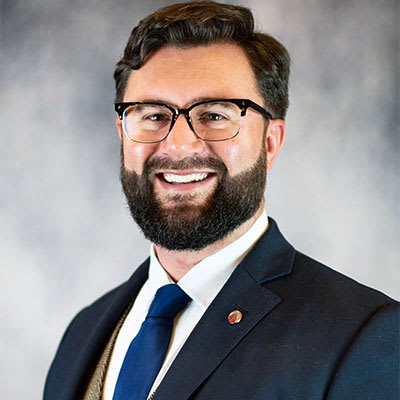 through the aviation ecosystem. He is a UAS Traffic Management expert with direct operational experience orchestrating the safe and efficient navigation of over 13,000 drones. Dan is a global top 20 AAM industry leader, according to eVTOL Insights Powerbook, and earned Community Engagement Team of the Year in 2024. As President of Electro.Aero, Dan is a champion of charging protocol harmonization for reliable and affordable electric aviation infrastructure networks. As Academic Coordinator of the Master's in AAM at ITAerea Aeronautical Business School in Spain, he seeks to inspire the next generation of aviators and frequently gives guest lectures.