The Future of Airspace Management
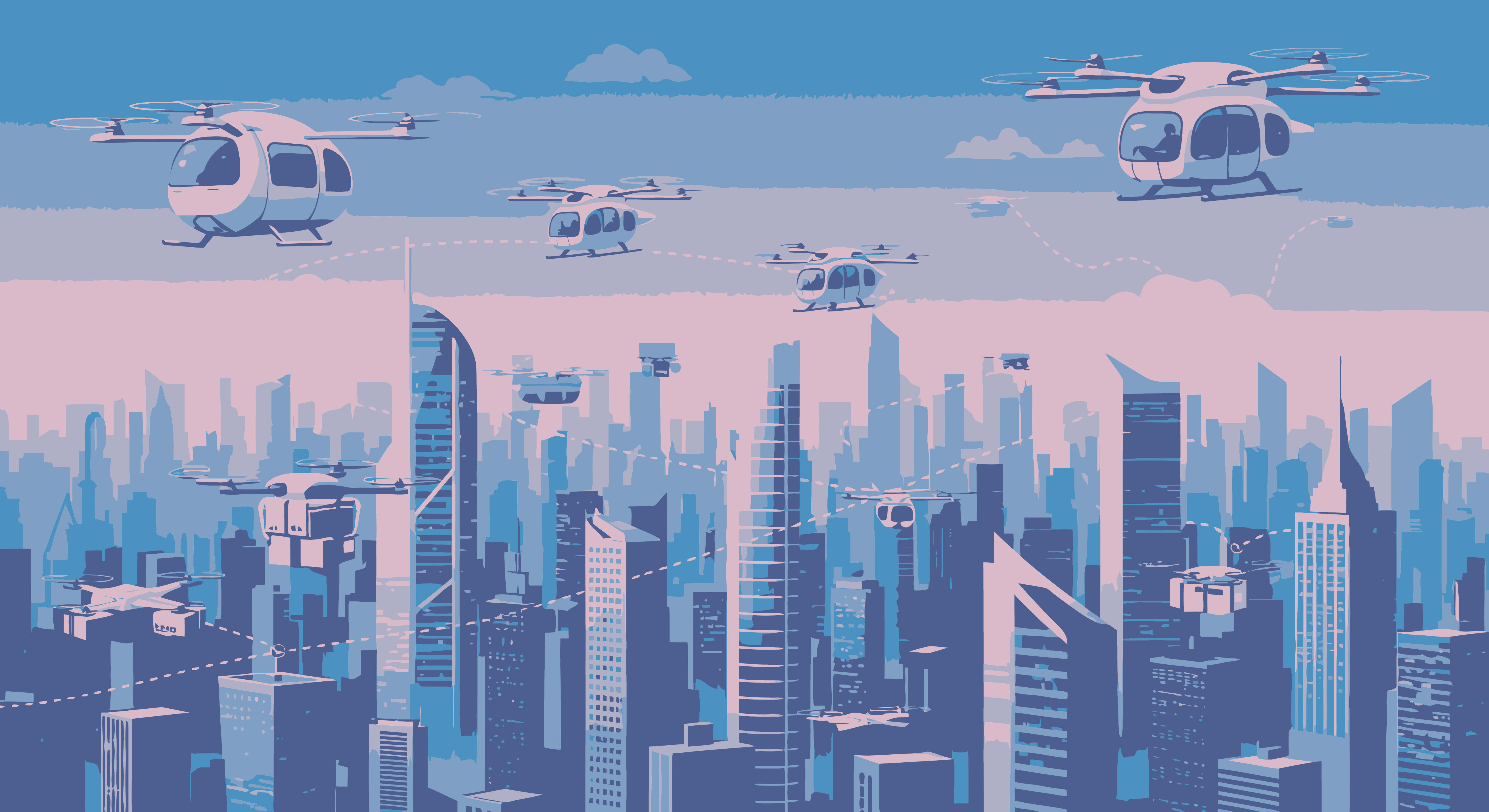
Source: AryKsm/stock.adobe.com; generated with AI
Advanced air mobility (AAM)—which includes urban air mobility (UAM) operations—is quickly shifting from experimental flights to real-world operations, bringing a surge of new aircraft into already busy skies. From electric vertical take-off and landing (eVTOL) vehicles to autonomous drones, these systems will operate at lower altitudes and in far greater numbers than traditional aviation. Safely integrating them requires more than new airframes: it calls for fresh thinking in airspace management, advanced simulation, and a robust, data-centric digital infrastructure.
Eduardo García, Senior Manager for Future Skies at the Civil Air Navigation Services Organization (CANSO), is deeply involved in shaping that future. He leads international efforts on innovation and AAM, working through the International Civil Aviation Organization (ICAO) and the Complete Air Traffic System (CATS) Global Council to define how air traffic management (ATM) must evolve to serve both traditional commercial aviation and new entrants such as drones, eVTOLs, and higher-airspace operations.
We recently spoke with García about the barriers to adoption of eVTOL and the ways simulation, data analysis, and new traffic management concepts can help create a safe, integrated airspace.
Mouser Electronics: What first drew you to the UAM world—and what keeps you motivated to tackle such a complex challenge?
Eduardo García: My passion has always been research and innovation. Before joining CANSO, I worked at Spain's ATM R&D+innovation Reference Centre (CRIDA) and at the University of Aeronautical Engineering in Madrid.
Aviation is unique: Breakthroughs in a lab aren't enough; progress only happens when stakeholders—manufacturers, air navigation service providers, airports, regulators, airlines—move together.
When I joined CANSO, I realized I could combine innovation with international cooperation. My role allows me to explore new concepts, anticipate future aviation needs, and help bring ideas to life. A few years ago, it became clear that today's ATM systems were never designed for the scale and diversity of operations coming with eVTOLs, drones, and new space activities. We're talking about very high densities of vehicles, each with different performance characteristics, sharing the same airspace.
To tackle this, CANSO launched the CATS Global Council, a think tank bringing together traditional aviation stakeholders and new entrants such as drone operators, eVTOL manufacturers, and digital ATM innovators. What keeps me motivated is knowing this isn't just an incremental change; it is likely the biggest transformation aviation has faced in the last 50 years. Making it work requires rethinking systems and bringing together everyone involved, including regulators, cities, manufacturers, and communities.
From a technology standpoint, eVTOLs look ready. Why aren't we already seeing hundreds of them in the sky?
Certification is the first hurdle. These vehicles are making remarkable progress, but they can't fly commercially until regulators approve them. Harmonized processes are crucial to ensure that criteria align across regions, such as Europe and the United States.
Once certified, the next challenge is scaling operations. eVTOLs have unique performance profiles and are expected to fly in larger numbers, day and night, than today's helicopters. The fundamental determinant of success is infrastructure. eVTOL viability hinges on achieving high utilization, making both ground infrastructure and ATM critical. Our current ATM system isn't built for this density or variety. Integrating these vehicles safely requires a new approach to traffic management—one that emphasizes automation, digital information management, and seamless coordination among all stakeholders.
What does that new approach look like?
The new approach represents a foundational transformation of ATM. It must be far more automated, data-driven, and interconnected than anything we have today. Human cognitive capacity has limits, especially as traffic scales up, so success depends on real-time, system-wide data sharing—from vehicle-to-vehicle communications to seamless exchanges between aircraft, ground systems, and service providers.
This means building an architecture where information flows continuously and securely, enabling predictive decision-making and collaborative management across all actors. Automation becomes a partner rather than just a tool, allowing machines to handle tactical tasks while humans focus on strategic decisions.
Simulation and sandbox testing are equally critical. They allow us to stress-test concepts like detect-and-avoid algorithms, digital flight rules, and dynamic separation minima before integrating them into live operations.
Simulation and data analysis are increasingly being used to test these systems before they're deployed. What role do you see them playing in integration?
Simulation is absolutely critical. It allows us to model scenarios that would be impossible—or unsafe—to test in the real world. For example, we can simulate how a high density of eVTOLs interacts with commercial airliners near a busy airport, or how autonomous detect-and-avoid systems respond to unexpected conflicts.
But simulation alone isn't enough. We must feed it with real operational data from pilot programs, drone flights, and emerging Unmanned Aircraft System Traffic Management (UTM) systems to validate models and ground them in reality.
Data analysis then becomes the bridge, identifying patterns, measuring safety performance, and helping us refine rules before scaling up. In short, simulation lets us look ahead, and data analysis grounds that vision in evidence.
How does CANSO coordinate so many stakeholders—traditional aviation, new entrants, regulators—around a single vision?
Collaboration is central to CANSO's mission. A few years ago, we recognized that the future of air traffic management couldn't be shaped by ANSPs alone. To create a truly global, industry-driven vision, CANSO established the CATS Global Council—a think tank bringing together airlines, airports, major manufacturers such as Airbus and Boeing, technology providers including Indra, Frequentis, and Thales, drone operators like Wing, eVTOL manufacturers such as Joby, and research bodies including NASA.
The Council's primary task was to draft the CATS Concept of Operations (CONOPS) for Future Skies, a 20-year roadmap toward a seamless, highly automated airspace. This shared vision now informs ICAO's AAM Vision and the Global Air Navigation Plan.
We also publish targeted papers—such as our Think Paper on evolving flight rules—to guide international standards. In this way, CANSO acts as a global facilitator, aligning industry and regulatory stakeholders so that states can implement changes with confidence.
Paint a picture of that future. How far out are we talking?
Aviation evolves deliberately because safety is paramount, so full maturity is likely 20 to 30 years away. The CATS Global Council Concept of Operations (CONOPS) for Future Skies lays out three evolutionary phases:
Phase 1—Trajectory-Based Operations (TBOs): Shift from today's flight-plan–centric approach to continuous, data-rich trajectory management for more predictable and efficient operations.
Phase 2—Advanced Automation and Digitalization: Introduce higher levels of automation, dynamic separation minima, and extensive system-wide information sharing to manage growing traffic complexity.
Phase 3—Seamless and Highly Automated Airspace: Enable globally interoperable, largely self-separating operations in which humans oversee strategic safety and performance rather than tactical control.
This phased pathway provides a realistic roadmap toward complete digitalization, interoperability, and a truly seamless, highly automated airspace.
You mentioned global engagement. What have you learned from different regions?
Every region offers unique opportunities and challenges.
Africa shows how innovation can leapfrog legacy constraints. With limited entrenched infrastructure, some states can adopt the latest digital technologies directly—using drones for medical delivery or advanced automation for regional connectivity. But recent CATS Africa workshops revealed that progress hinges on political will, reliable funding, and cross-border data sharing.
Europe, by contrast, benefits from highly developed infrastructure, but its complex regulatory environment remains the principal constraint.
In the Middle East, rapid traffic growth and ambitious hub-expansion plans drive strong interest in AAM. Yet, the region faces challenges in regional coordination and cross-border harmonization to keep pace with this growth.
Latin America combines dense metropolitan areas with vast remote regions, making AAM and drone services for cargo and medical delivery particularly promising. However, uneven regulatory readiness and infrastructure investment across states remain significant barriers.
The Asia-Pacific region is exceptionally dynamic. Megacities, from Tokyo to Jakarta, face severe ground-traffic congestion, creating strong demand for eVTOL services, while Pacific Island states view AAM as a lifeline for inter-island connectivity. The key challenge is coordinating diverse regulatory regimes and ensuring interoperability across a region with vast economic and infrastructural differences.
Across all regions, the common thread is clear: Air traffic management must be digitally ready from day one. Beyond passenger travel, many states are prioritizing AAM applications such as medical delivery, emergency response, and low-emission cargo operations to support local development and climate goals. Whether in Africa, Europe, the Middle East, Latin America, or Asia-Pacific, success depends on real-time data sharing, harmonized standards, and strong political commitment so that new entrants—from eVTOLs to higher-airspace operations—can be safely integrated into a globally connected sky.
How do you ensure that this technology benefits society and not just technology companies?
That principle guides everything we do. We often say, "This is not technology for the sake of technology." Whether it's transporting organs, supporting emergency response, or enabling precision agriculture, every initiative must deliver clear, tangible public benefits. AAM goes well beyond passenger air taxis; it includes cargo and middle-mile logistics, last-mile delivery of critical medical supplies, humanitarian relief in disaster zones, infrastructure inspection, and even United Nations (UN) operations in remote or conflict-affected regions. These use cases directly support the UN Sustainable Development Goals by enhancing access to essential services and facilitating low-emission, greener transportation. Only when communities recognize this value will people adopt advanced mobility—and [will] governments invest in the necessary infrastructure to make it happen.
Finally, what excites you most about the next phase?
The potential to build a truly global, interoperable, digitally enabled airspace system. Seeing experts from legacy aviation and startups collaborate—and agree on a path forward—is inspiring. If we continue to build trust, share data, and embrace automation, we can create a future where people and goods move safely through the skies in ways we can scarcely imagine today.
Conclusion
The safe integration of eVTOLs and other AAM operations is not just an engineering challenge. As Eduardo García explains, it is a multidimensional transformation that requires advances in technology, regulation, infrastructure, and governance. Simulation and data analysis will play a critical role in testing and refining concepts, while new traffic management frameworks, such as the CATS Global Council's CONOPS, provide the roadmap. Above all, García emphasizes collaboration: only by working together can aviation authorities, innovators, governments, and communities build the safe, seamless, and sustainable airspace of the future.
 Dr. Eduardo García is the Senior Manager for Future Skies at CANSO, where he leads efforts to advance the vision for future Air Traffic Management (ATM) services and coordinates the Complete Air Traffic System (CATS) Global Council. He is actively involved with ICAO, serving as co-Chair of the Aviation System Block Upgrade (ASBU) Panel Project Team and Co-Rapporteur of the ICAO Advanced Air Mobility (AAM) Vision group. Previously, he managed European ATM Coordination and Safety at CANSO and was an Associate Professor at the Universidad Politécnica de Madrid. Eduardo holds a PhD in Aerospace Engineering (Cum Laude) and has received prestigious awards from SESAR and the Institution of Mechanical Engineers in the UK for his contributions to ATM innovation and safety.