A Tiny Component with a Large Impact on EV Charging

(Source: The Stock Photo Girl/stock.adobe.com; generated with AI)
Published April 30, 2026
To promote the changeover from internal combustion engine vehicles to electric vehicles (EVs), governments and regulatory entities around the world are expanding the rollout of charging infrastructure as quickly as possible. That urgency is placing great demands on infrastructure providers, who are simultaneously responding to demands for higher-powered chargers.
In locations such as the European Union (EU), fast charging is being mandated by law; meanwhile, consumers are the driving force in other locations. The International Energy Agency (IEA) estimates that the total number of public chargers increased to over 5 million in 2024, the same year in which the number of fast chargers (22kW–150kW) reached 2 million, and ultra-fast chargers (150kW+) grew by over 50 percent.[1] Another complex layer for infrastructure providers is the increasing demand for bidirectional charging. These trends are ongoing and likely to accelerate.
This blog explores why charger control circuitry for various types of EVs (collectively known as xEV) faces growing signal integrity and isolation design challenges as charging infrastructure scales, form factors shrink, power levels rise, and reliable Power Line Communication (PLC) becomes central to international charging standards. Then, we explain how pulse transformers are engineered to preserve PLC performance, provide isolation, and enable reliable communication in modern xEV charging systems.
Why Control Circuits in EV Chargers Are Uniquely Demanding
Much of the discussion around EV chargers focuses on the power electronics that support increasing power levels, but the control circuitry driving power electronics is the key for reliable performance. EV chargers have two main sections: the power stage handles energy conversion, while the control stage ensures the charging process is carried out safely and efficiently.
The control signal can be delivered as a separate communication interface or via PLC, where data is carried over the Control Pilot (CP) line within the charging interface. This delivery method avoids the need for a separate dedicated data cable within the charging interface and helps reduce system complexity, weight, and connector count.
Both the North American Charging Standard (NACS) and Combined Charging System (CCS) standards use PLC for charging. Standards such as ISO 15118 define the electrical and communication requirements for PLC-based charging, including signal strength and noise tolerance, which directly impact control circuit design.[2] The design process is further being challenged due to the ongoing standards convergence to allow the vehicle to automatically identify itself and negotiate charging in an easy plug-and-charge process.
Ensuring the quality of the control signal is vital for charging and is also integral to meeting relevant standards for certification. A weak control signal, or one affected by interference, can lead to failures in managing the charging session and stop the charger from communicating with the battery management system (BMS). Every component, wire, or connector in the control line introduces insertion loss, which attenuates and distorts the broadband PLC signal. There are larger insertion losses at higher frequencies that do affect PLC communications in the 2MHz to 30MHz range.
In addition to the signal degradation, there are other threats to signal integrity. The current trend to reduce charger size means that the control and power electronics share a smaller circuit board. To make designs more power-dense and efficient, wide bandgap (WBG) electronics are often used. These devices switch large amounts of current very quickly, which can cause significant electromagnetic interference (EMI) in a frequency range similar to PLC. Additionally, fast transients and variable cable impedance can affect control signal integrity.
The Value of Pulse Transformers
Dealing with control signal quality challenges makes the pulse transformer one of the most important components in the charging process. These devices use magnetic coupling to rapidly transfer high-speed rectangular pulses between circuits with minimal distortion. In an EV charger, they preserve the integrity of the control signal while providing the galvanic isolation that protects the control circuit from the power circuit and EMI (Figure 1). Pulse transformers can also be useful for blocking the DC component of the signal and suppressing common-mode noise. Other options for performing these tasks are less effective, and they involve making a trade-off between frequency behavior and noise immunity.
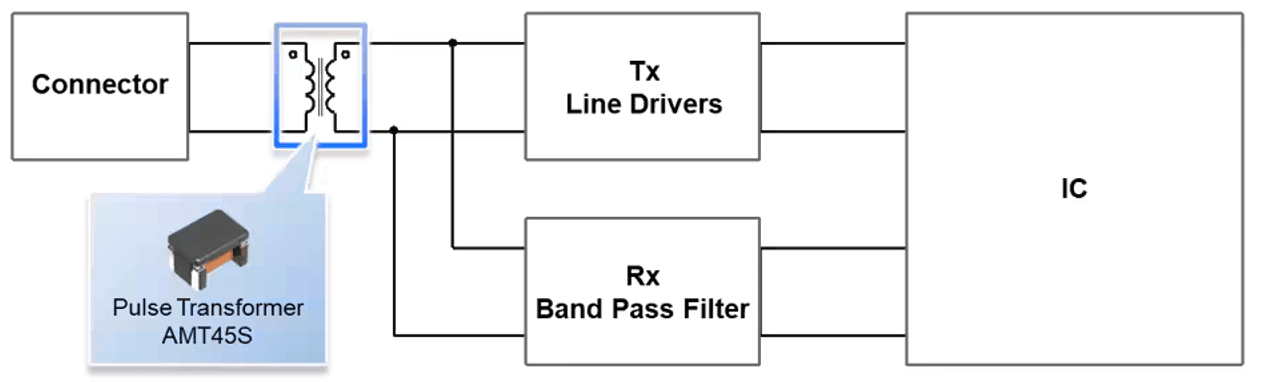
Figure 1: Pulse transformers are vital in a PLC circuit to preserve signal integrity and protect the control circuit from the high-power circuit and noise. (Source: TDK)
In order to minimize signal degradation, pulse transformers in EV charging applications must maintain low insertion loss across the full 2MHz to 30MHz transmission bandwidth.
While several transformer topologies can meet these electrical requirements, toroidal-type pulse transformers are commonly used in PLC communication circuits. However, their traditional manual winding process can make it difficult to achieve consistent winding quality. Furthermore, to withstand high voltages, they are often coated with resin, further increasing both size and cost.
A New Approach to Pulse Transformer Design
In PLC-based EV charging control circuits, pulse transformers are designed for signal performance instead of traditional power-stage isolation. Fully automated winding techniques improve consistency and reduce variability, which helps minimize insertion loss. These approaches also support smaller form factors and more cost-effective manufacturing compared to manually wound designs.
In addition, ferrite selection and winding geometry can be engineered to maintain low insertion loss across the full 2MHz to 30MHz PLC frequency range. For xEV PLC applications, removing unnecessary insulation further reduces size and parasitic effects, without compromising performance, since control circuits do not require the same isolation levels as high-power components connected directly to the grid.
AMT45S Pulse Transformers in xEV Charging Control Circuits
The AMT45S from TDK is a pulse transformer that has been designed specifically to meet the needs of PLC communications in EV charging applications. It is manufactured using fully automated winding technology, and the lack of a resin coating helps reduce the size and make these transformers more cost-effective than other solutions. The ferrite and winding geometry have been developed from the ground up to provide the lowest possible insertion loss across the whole 2MHz to 30MHz frequency band (Figure 2).
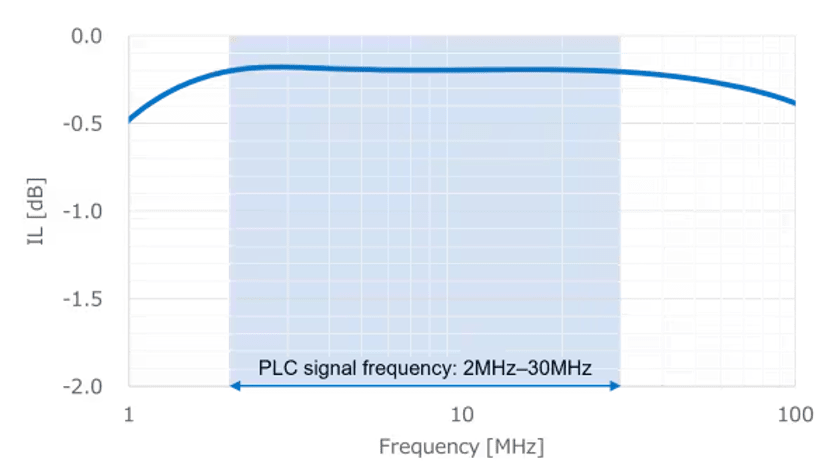
Figure 2: The TDK AMT45S shows a remarkably low insertion loss across the whole PLC frequency range. (Source: TDK)
The AMT45S pulse transformer is engineered to be as reliable as possible over a long operating lifetime. Its small footprint makes it ideal for use at the center of noise-resilient control layouts. The device is also suitable for use in both on-board chargers and in charging stations. To support design integration, the device has been validated with multiple PLC chipsets, including Qualcomm’s QCA series and Lumissil’s IS32CG family.
Conclusion
As EV charging infrastructure continues to scale, the reliability of control-circuit communication has emerged as a defining factor in overall charger performance. Preserving PLC signal integrity amid higher power levels, tighter layouts, and increased EMI requires careful attention to every element in the communication path, making pulse transformers a critical enabler rather than a supporting detail. Purpose-built solutions like TDK’s AMT45S show how advances in transformer design—through low insertion loss, effective isolation, and compact form factors—can directly support standards-compliant, noise-resilient PLC communication in modern xEV chargers.
With charging systems continuing to evolve, it is becoming increasingly clear that the future of fast, reliable EV charging depends not only on how efficiently power is delivered, but on how cleanly and consistently control signals are carried alongside it.
[1]https://www.iea.org/reports/global-ev-outlook-2025/electric-vehicle-charging
[2]https://www.iso.org/standard/77845.html
Author Bio
 Since graduating with a BSc in Electronic Systems from the University of the West of Scotland in 1997, Alistair Winning has worked in electronics media across marketing, PR, and journalism roles. During that time, he worked as the editor of Electronics Engineering, Embedded Systems Europe, EENews Embedded, Technology First, Electronic Product Design and Test, and Panel Building and Systems Integration magazines. Currently, Allistair is the European Editor of Power Systems Design and a freelance writer, specializing in electronics and engineering.