Implementing Efficient Motor Control and Sensing for AI Data Centre Liquid Cooling CDUs

Image Source: Mouser Electronics
By Stuart Cording, Mouser Electronics
Published June 22, 2026
Ordering components online, accessing datasheets, and interacting on forums about development challenges all rely on data centres. Now data centres are entering a new phase, offering GPU-powered artificial intelligence (AI) to handle the growing use of large language models (LLMs). This has brought a rumbling issue into the spotlight: how do we best deal with the heat these data centres generate?
Where Does All the Data Centre Heat Come From?
A key problem with data centres is that, while CPUs and GPUs are very efficient at processing, all the energy they consume is turned into heat. Both processors have a defined Thermal Design Power (TDP)[1] that specifies their power consumption under maximum theoretical load. CPUs in classic servers have a TDP of up to 400W. When combined with the energy consumption of RAM, network cards, storage, the motherboard, and fans, a dual-socket server can dissipate between 1.3kW and 1.5kW as heat.
AI servers are dramatically changing these calculations. NVIDIA’s H100 SXM has a TDM of 700W. Usually installed eight to a server, supported by two CPUs, and fitted with a terabyte or more of RAM, you’re quickly dealing with up to 8kW of heat. With up to eight AI servers per rack, engineers are now dealing with 20kW more heat removal than with a typical 40 classic server rack (Figure 1).

Figure 1: A classic data centre can pack up to 40 servers into a rack. (Source: WavebreakMediaMicro)
Moving From Air to Liquid Cooling
Dissipating this heat using air alone is increasingly challenging. Fans are bulky and are a significant source of noise. Inside the data centre, noise levels of up to 85dB (A) are common, peaking at 90dB (A)[2] in some areas. That’s as loud as a passing bus on the high street, but every hour of your working day. Furthermore, air doesn’t have the best thermal conductivity or capacity.
Instead, data centre designers are integrating water-cooling solutions that attach directly to GPUs and CPUs. Water is 23 times better at conducting heat and can hold 3,000 times more heat[3] by volume.
Coolant distribution units (CDUs) are being used to implement direct liquid cooling (DLC), or direct-to-chip cooling, at the chip level. This cooling loop is kept independent of the facility water system (FWS) and chiller to maintain the integrity of the chip coolant (Figure 2).
Critical tasks for the CDU are temperature, flow, and pressure control, and coolant monitoring. The transition to liquid cooling, however, is taking time. Currently, there is no single approach, and CDUs are found in the rack, in-row to cool multiple racks, or centrally as a gallery at facility scale.[4]
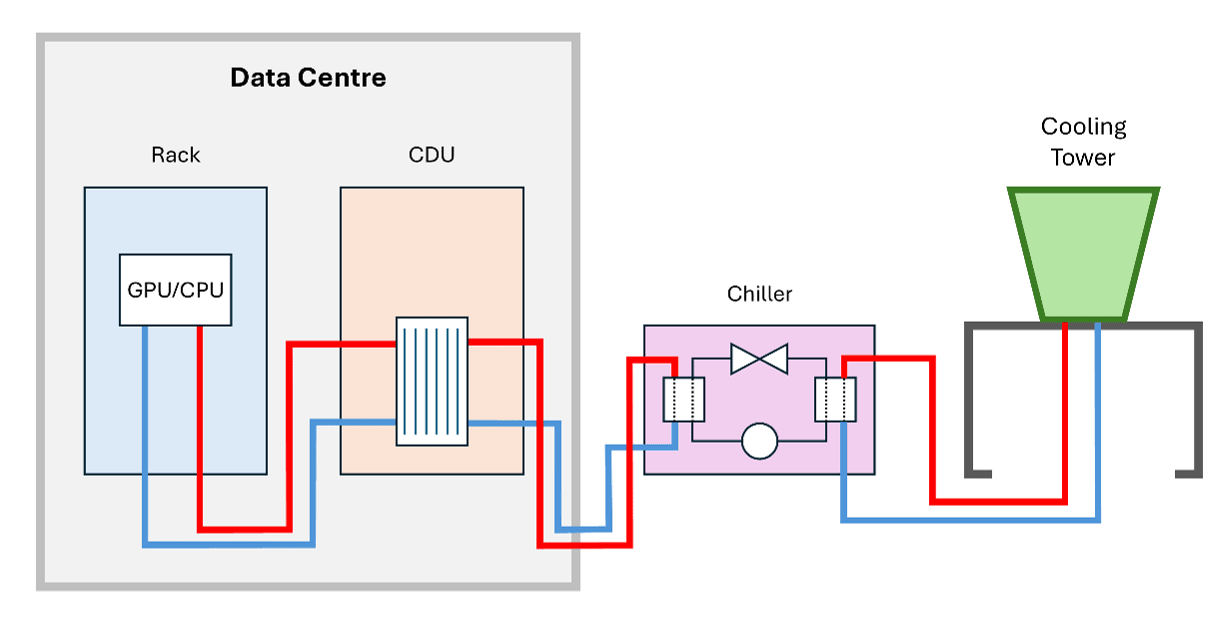
Figure 2: Simplified architecture of CDU deployment in a data centre. (Source: Author)
Keeping the Liquid Flowing with Pumps
Reliability and efficiency are the clear requirements for the CDU’s pump. Liquid must be kept moving continuously, while there is a clear need to keep any additional heat generation to an absolute minimum. This constraint guides the developer to a motor control solution that supports control of sensorless brushless DC (BLDC) or permanent magnet synchronous motors (PMSM).
One popular solution is provided by Texas Instruments, with their C2000 Real-Time Microcontrollers such as the F28E12x. Built around their C28x processor, a single-cycle instruction RISC core with a floating-point unit (FPU), the device is architected for the deterministic control required in motor inverter and digital power converter applications. Development hardware, such as the TIEVM-MTR-HVINV MCU Evaluation Module, provides a rapid entry point to exploring this processor family and FOC control of PMSMs (Figure 3). This module is backed up by software development tools[5] for sensored and sensorless control.

Figure 3: This PMSM motor control evaluation module can be used together with C2000 real-time microcontrollers. (Source: Texas Instruments)
The F28E12x features high-performance analogue blocks, including an 8.9 MSPS, 12-bit analogue-to-digital converter (ADC), three windowed comparators, and a programmable gain amplifier, critical for monitoring voltage and current during motor control. Equally important are the eight pulse-width modulation (PWM) channels and enhanced capture and encoder pulse peripherals. These support the implementation of both PFC and motor inverter using a single device. The capture peripherals simplify the integration of sensored operation using optical, magnetic, or pulse encoders. All of these peripherals are tightly coupled with the processor to simplify and speed up the algorithmic decision-making required for accurate, efficient motor commutation.
Efficient, Compact Power Delivery
Silicon MOSFETs are approaching their limits in many power converter applications, limiting the design engineer’s ability to shrink volume, increase density, or achieve more complex form factors. With the introduction of wide bandgap (WBG) devices, such as GaN FETs, this is starting to change. Some of the benefits come from the higher attainable switching frequencies. However, getting the driver stage matched to the gate and minimising parasitic effects to deliver these benefits is challenging.
This challenge is why GaN suppliers, like Texas Instruments, are offering GaN FETs with integrated drivers, such as the LMG3100R0x. The 100V, 126A, 1.7mΩ LMG3100R017 GaN FETs are matched with a single high-frequency GaN driver with excellent propagation delay (min. 38ns) and matching (min. 4ns). Housed in a single package, this minimises parasitic effects. Two devices can be easily linked to form a half-bridge thanks to the integrated high-side level shifter and bootstrap circuit. At the same time, the top-side cooling QFN and large bottom-side GND pad simplify integration into novel housing designs, opening up new approaches for heat dissipation (Figure 4). The driver requires 5V bias power, supports 3.3V and 5.0V input logic levels, and can switch at 10MHz.

Figure 4: With top-side cooling in a QFN package, this GaN FET with integrated driver makes it easier to attain the benefits of WBGs in motor control applications. (Source: Texas Instruments)
Implementing Monitoring and Control
While the ADC of the F28E12x is optimised for motor control, the CDU application has a range of other monitoring requirements that have little need for high-speed conversion, but may demand higher measurement resolution. Thus, it may make more sense to collect measurements from temperature probes and flow and pressure sensors using an external ADC. Conceived for use in field transmitters in industrial applications, the ADS122C04 24-Bit ADC may be just what is needed.
The device offers four single-ended inputs or two differential inputs, linked via a flexible multiplexer to its 24-bit sigma-delta ADC. This architecture allows a programmable gain amplifier (PGA) to be switched into the signal path when needed (Figure 5). A constant-current source (10µA to 1.5mA) is also available, as required by PT100 resistance temperature detectors (RTDs). To ensure that all the required sensors can be supported, its I2C bus provides 16 configurable addresses, along with standard, fast, and fast-mode-plus bus speeds.

Figure 5: The ADS122C04 is ideal for implementing industrial temperature, flow, and pressure sensing for a CDU. (Source: Texas Instruments)
Building Efficient, Reliable CDUs for AI Data Centres
One thing is clear: Data centres, especially those handling AI workloads, need a transformation in their cooling architecture. Blasting air through server racks is no longer the way to go. Liquid-to-chip cooling leverages water’s heat-conduction and heat-absorption properties. In this application, the reliability and efficiency of the CDU are critical. Failure to keep the coolant moving will result in a critical thermal event and potentially permanent damage. Devices like the F28E12x are ideal for controlling BLDC and PMSM pumps and can integrate the PFC if desired. When integrated with GaN FETs such as the LMG3100R0x, designers can benefit from the efficiency improvements of WBG materials, while avoiding the challenges of parasitics. Finally, mission-critical sensor integration for temperature, flow, and pressure is easily implemented using highly integrated analogue devices, such as the ADS122C04 24-Bit ADC.
Sources
[1]https://www.intel.com/content/www/us/en/support/articles/000055611/processors.html
[2]https://acousticalsolutions.com/data-center-noise-pollution
[3]https://acousticalsolutions.com/data-center-noise-pollution
[4]https://www.vertiv.com/en-asia/insights/articles/educational-articles/evaluating-coolant-distribution-unit-cdu-architectures-advantages-considerations-and-best-use-cases/
[5]https://www.ti.com/tool/C2000WARE-MOTORCONTROL-SDK
Author Bio
 Stuart Cording is “The Electronics Reporter”—an engineer turned influencer dedicated to helping the electronics community make sense of today’s complex technologies. With 30 years of experience in semiconductors and embedded systems, he uncovers the stories, insights, and practical know-how that help engineers solve real design challenges. Through articles, podcasts, and videos, Stuart connects innovators, shares technical wisdom, and celebrates the people driving progress in deep tech.