Will Quantum Overtake AI? Two Experts Weigh In
Ask a room full of technologists about quantum computing and artificial intelligence (AI), and you are likely to hear one of two opinions. Some will say they’re a perfect pairing, destined to supercharge each other. Others expect that quantum computing will eventually make AI obsolete. However, neither side is entirely true, and the relationship between quantum computing and AI is widely misunderstood.
To cut through the noise, we spoke with two experts who work in each of these fields. Dr. Mikko Möttönen and Becks Simpson. Möttönen is a Full Professor of Quantum Technology at Aalto University and Chief Scientist and Co-Founder of QMill, which develops quantum algorithms that push the boundaries of what today’s noisy hardware can do. Simpson brings a decade of experience implementing AI systems in production, with a research background that includes work at Mila, one of the world’s leading AI research institutes. Each explained how the other’s technology contributes to their own, and where the hype outpaces reality.
What emerged is a picture far more nuanced than either dominant narrative allows. These are complementary technologies that solve fundamentally different classes of problems. On top of that, the relationship between them is asymmetric: AI is concretely helping quantum today, and quantum’s contributions to AI remain largely theoretical, with a few notable near-term exceptions.
Dr. Mikko Möttönen is Academy Professor and Full Professor of Quantum Technology at Aalto University and VTT Technical Research Centre of Finland, as well as Co-Founder and Chief Scientist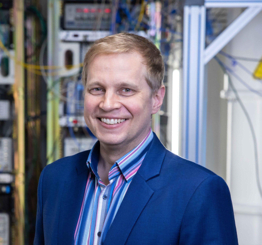 of QMill and Co-Founder of IQM. His work spans quantum computing, superconducting qubits, quantum algorithms, nanoelectronics, and quantum devices, with expertise in gate optimization, decoherence, and noisy qubit systems.
Becks Simpson is a Machine Learning Lead at AlleyCorp Nord where developers, product designers and ML specialists work alongside clients to bring their AI product dreams to life. She has worked across the spectrum in deep learning and machine learning from investigating novel deep learning methods and applying research directly for solving real world problems to architecting pipelines and platforms to train and deploy AI models in the wild and advising startups on their AI and data strategies.
Foundational Concepts of Quantum Computing and AI
Quantum computing exploits the principles of quantum mechanics to perform calculations in ways classical computers cannot. Information is encoded in qubits, which can exist in weighted combinations of 0 and 1 simultaneously (i.e., superposition) rather than committing to one value. Multiple qubits can be correlated so that the state of one constrains the others (i.e., entanglement). Quantum operations are designed so that paths leading to wrong answers are canceled out, while paths to correct answers are reinforced (i.e., interference).
AI, and specifically the techniques that dominate the field today, excels at finding patterns in large, real-world datasets. Modern AI models learn compressed representations of data, capturing statistical structure in billions of parameters that can then be used for prediction and generation.
Core Capabilities of Quantum Computing and AI
Quantum computing offers advantages for particular problem structures and algorithm classes, especially when the number of possible configurations increases so rapidly that classical computers would take a massive amount of time to solve them. The textbook example is integer factorization. Given the product of two large prime numbers, working backward to find those primes is computationally infeasible for classical machines. This theoretical curiosity is the mathematical foundation of RSA encryption and some public-key cryptography.
“If some problem scales linearly, which means you double the problem size and double the hardness for a classical computer, that’s easy for a classical computer. You should not use quantum computers for such problems,” Möttönen explains. “Classical computers have this huge head start in their development. They’re super fast. For that reason, quantum computers, for many decades at least, don’t have a chance to beat classical computers in such easy problems.”
Where quantum computing shines is in problems where classical approaches can only approximate, and where better approximations carry real value. Möttönen offers a tangible example: Imagine fitting 1,000 differently shaped blocks into a box. Classical methods produce decent packing solutions, but quantum computers can find tighter fits. “Even classically, answers may be good enough. If you don’t use 5 percent of your capacity, you can still do business. But quantum computers might give you that 5 percent advantage compared to your competitors, and in time, it would accumulate.”
AI operates in a completely different space. “AI is exceptionally good at tasks where you have large amounts of unstructured, real-world data, and you need to extract structure from it,” says Simpson. “[Such as] domains where you can’t write down a clean mathematical formulation of the problem, so you need a system that can learn the patterns empirically. And the vast majority of those algorithms are matrix-based—operations that classical computers already handle extremely well.”
The dominant narratives about quantum and AI rest on the assumption that they address the same types of problems, with quantum computing often thought of as a faster computer. However, looking at what each technology actually targets, that is not the case. The relationship gets interesting at the boundaries; both quantum computing and AI have limits and niche areas that the other could address, and vice versa.
Current Contributions
Both experts are careful to draw a line between what’s real and what’s aspirational. “There’s a meaningful distinction that gets lost in most coverage of this topic. AI is actively helping quantum hardware and algorithms right now, but actually running useful AI models on quantum computers isn’t there yet,” says Möttönen. He adds, “It would require large-scale, fault-tolerant hardware that doesn’t exist yet and likely won’t be [available] for probably another decade.”
The technologies’ concrete contributions fall into two main categories. The first is noise characterization and error mitigation. Qubits are extremely sensitive, and the signals they produce are weak and noisy. When measuring a qubit, the raw data doesn’t simply display a 0 or a 1. A complex signal is buried in noise, and deciding what it actually represents is a non-trivial problem.
“There is a huge amount of data coming from the measurement, and then you have to analyze that data quickly to decide whether it told you the qubit was zero or one,” Möttönen explains. “The noise has certain characteristics which are difficult to analyze with systematic methods. AI models can learn the noise distributions. Based on that model, you get higher accuracy in your measurements.” He’s quick to temper expectations: “It’s not like a magic wand. It doesn’t make your 10 percent accuracy 99 percent. But it helps.”
The second contribution area is circuit compression. Quantum computations are expressed as circuits—that is, sequences of logical operations applied to qubits. Longer circuits accumulate more errors on noisy hardware, so shortening a circuit without changing what it computes is valuable. QMill has developed AI models that do exactly this, reducing the number of operations by around 20 percent, though the improvement varies and can reach 90 percent in extreme cases.
“That 20 percent saving might not sound dramatic,” Möttönen points out. “But on noisy hardware, it can be the difference between a computation that produces meaningful results and one that’s buried in noise. It can determine whether a calculation is feasible at all.”
Common Misconceptions Surrounding AI
Along with the promise of AI and quantum computing come misconceptions about their relationship.
The first misconception is the assumption that AI can solve any problem given enough data and computing power. “There’s a persistent belief that if you just scale up, if you add more data and more [graphics processing units (GPUs)], AI will eventually crack any problem,” says Simpson. “That isn’t true. Scaling produces diminishing returns, and more fundamentally, some problems don’t have the training data to begin with. Some data that we need can only be generated by simulating quantum systems, and classical simulation of those systems is intractable. [So] no amount of scaling on the AI side helps. That’s precisely where quantum computing becomes relevant.”
The second misconception, according to Simpson, is that AI “understands” the problems it works on. Modern AI systems are sophisticated pattern-matching engines. They can produce remarkably coherent and useful outputs, but they do not reason from first principles the way a physicist or chemist does. This distinction matters because it clarifies what AI can and can’t contribute. Simpson notes, “It can optimize processes, find patterns, and compress information. But it can’t replace the need for fundamentally new computational approaches when the underlying problem demands them.”
Common Misconceptions Surrounding Quantum Computing
Besides the most widespread misconception that quantum is simply faster, Möttönen sees other misunderstandings that are just as damaging.
One is the idea that you can port an existing machine learning model to a quantum computer. “It’s not that you just try to fit your machine learning model into a quantum computer. It doesn’t work,” he says. The problems must be completely reformulated to exploit quantum phenomena such as interference and entanglement. Simpson sees a parallel on the AI side: “It’s a bit like the early days of GPU computing, where people assumed you could just run any code on a GPU and it’d be faster. You couldn’t. You had to rethink the algorithm. Quantum is an even bigger leap than that.”
Another misconception is that quantum hardware is exotic and inaccessible, something that costs tens of millions of dollars and sits in a government lab. Möttönen explains the disconnect, “What is difficult is to make the quantum computer, the machine that requires special technology. What is difficult is to make the algorithm. But once they’re done, they’re extremely easy to use and access through the cloud.” Simpson points out a parallel: “Large language models are the same. Few have the [infrastructure] to train and deploy those. But once someone has done it, everyone accesses it through layers of abstraction and cloud services.” Quantum may follow the same path.
Potential Impacts of Quantum Computing on AI
From Möttönen’s perspective, the most important thing to understand about quantum’s potential contribution to AI is what it’s not: “Quantum computers don’t really compute things faster. They don’t tick faster. They tick slower. It takes more time to do these operations, but it’s a different way of doing the logic. It’s an expanded logical space of operations.”
This distinction is critical. Quantum’s value to AI won’t come from doing classical tasks faster. It will come from making currently impossible computations possible and from making some existing computations more efficient so that less classical computational power is needed to achieve the same result.
One of the most promising near-term intersections is generating otherwise unobtainable training data. Notes Simpson, “In fields like chemistry, materials science, and drug discovery, the bottleneck for AI isn’t model architecture but rather, training data.” Simulating molecular interactions at quantum-mechanical fidelity is nearly impossible for classical computers beyond a certain scale. Quantum computers may someday generate this data natively.
“You would use quantum computers to solve problems that are classically almost impossible to solve, and train your AI model based on that data,” Möttönen explains. “This way, the model sees the reality that the quantum computer sees. It doesn’t see all of it, but it sees glimpses of it. And then it builds its model based on that.”
A more speculative possibility involves gradient descent, the core optimization process in training neural networks. “Classical gradient descent can get trapped in local minima, settling on a solution that works reasonably well but isn’t the best available,” says Simpson. “Quantum approaches could potentially explore the solution landscape more efficiently.”
The same logic applies to finance and logistics, where portfolio optimization and routing problems involve combinatorial explosions that quantum is naturally suited to. Some discrete optimization problems can be mapped into Quadratic Unconstrained Binary Optimization (QUBO) form, which is convenient for quantum annealing or some gate-model optimization workflows. That said, proof-of-concept work in these areas has not yet demonstrated an advantage over classical methods at a real-world scale. Möttönen frames this as a realistic hope for the near future, not a current capability.
Future Outlook and Strategic Implications
The relationship between quantum computing and AI is real, but asymmetric. Neither technology makes the other obsolete. They solve different problems, and increasingly, they will solve them together, but the overlap will never be 100 percent. Today, AI contributes to quantum in concrete, measurable ways across better noise characterization, shorter circuits, and smarter error mitigation. Quantum’s contributions to AI are largely future-facing, grounded in solid theory but awaiting hardware that can deliver on the promise.
The asymmetry in the relationship will shift. As fault-tolerant quantum computers become available, the ability to generate training data from quantum simulations, to explore optimization landscapes more efficiently, and to solve previously intractable subproblems will expand what AI systems can do. But the dominant narratives—that the technologies will supercharge each other, or that one will replace the other—miss the point. These are complementary tools with fundamentally different strengths, and understanding that distinction is what separates informed strategy from hype.