NearFi Delivers Contactless Power and Data for Automation

(Source: ainynoer/stock.adobe.com; generated with AI)
A single damaged cable on a rotary table can quickly shut a line down in a factory setting. This means stopping production, calling maintenance, and eating the cost of downtime. In systems that operate nonstop, standard wiring just isn't made for that kind of motion.
To keep these continuous systems running efficiently, engineers have to think about more than just power. They need data and control signals to keep moving, even while everything else is in motion. When motion becomes the norm, reliability must be a design priority rather than a convenience.
As this blog explores the motion-based design challenges engineers face in powering and communicating with work carriers and rotary tables, it will demonstrate how NearFi technology from Phoenix Contact provides a contactless, real-time solution for the deficiencies of traditional wiring, slip rings, and wireless communication methods.
Motion-Based Automation Components
Motion-based automation components, like work carriers and rotary tables, are basic components in industrial automation. They are responsible for constantly moving and positioning workpieces through the manufacturing, testing, and assembly processes. These systems move and position parts between stations, such as robotic arms, inspection points, or machining tools, as part of the steady production flow.
Work carriers, also known as workpiece carriers, move products along linear paths, between levels using elevators, or across overhead tracks (Figure 1). Since they operate repeatedly in fast-paced production cycles—often completing hundreds or thousands of transfers per shift—they are designed for constant motion under varying loads and travel distances.

Figure 1: A typical straight-line linear work-carrier system. (Source: aicandy/stock.adobe.com; generated with AI)
Rotary tables are also developed for repeated motion, but they rotate workpieces in predefined increments to support assembly, machining, inspection, and surface treatment operations. These tables commonly perform full 360° rotations and frequently reposition products across multiple tooling or inspection stations during each cycle (Figure 2).

Figure 2: A standard rotary table. (Source: Aania/stock.adobe.com)
Because each of these automation systems run in constant motion, power and data connections that depend on physical wiring are repeatedly stressed and become prone to failure as a result.
The Power and Signal Transmission Challenge
Designing power and data delivery systems for motion-based automation equipment presents multiple reliability challenges. Traditional wiring is not dependable in these environments because constant motion can cause conductors to tire, tangle, or break over time. For rotary motion, slip rings are often used as an alternative power-transfer method, but their brushes are still in constant contact with the rotating ring, similarly leading to friction, wear, and regular maintenance. Under changing loads, slip rings can also present electromagnetic interference (EMI) that disrupts system performance.
Data transmission presents its own set of issues. In high-speed automation, receiving control signals or fault alerts in real time is critical. Even a millisecond delay can affect process accuracy or cause mechanical damage. In some cases, wireless systems such as WLAN (Wireless Local Area Network) and Wi-Fi® are used to eliminate physical connections, especially when parts are moving and it's difficult to keep wires attached. Those connections, though, may not consistently maintain deterministic, low-latency communication in demanding industrial conditions.
These challenges illustrate why there's a need for transmission methods that can support continuous motion without mechanical wear, all while providing real-time Ethernet communication with high reliability.
NearFi Technology Designed for Reliability
Phoenix Contact's NearFi technology was developed specifically to resolve the power and data transmission challenges that come with continuous motion in automation systems. NearFi doesn't depend on physical contacts or cables that eventually wear out or introduce electrical noise. Instead, it transfers both power and Ethernet data wirelessly across a short air gap, while maintaining real-time performance.
Phoenix Contact’s lineup of NearFi couplers includes the NEARFI PD 2A ETH B, NEARFI P 2A B, and NEARFI P 2A R, which enable contactless, real-time Ethernet connections and power transmission up to 50W across an air gap of a few centimeters (Figure 3). This approach eliminates slip ring brush wear and avoids cable failure caused by rotational or linear stress. Since they use common A-coded M12 connectors, these couplers can drop into typical automation wiring schemes without special adapters.
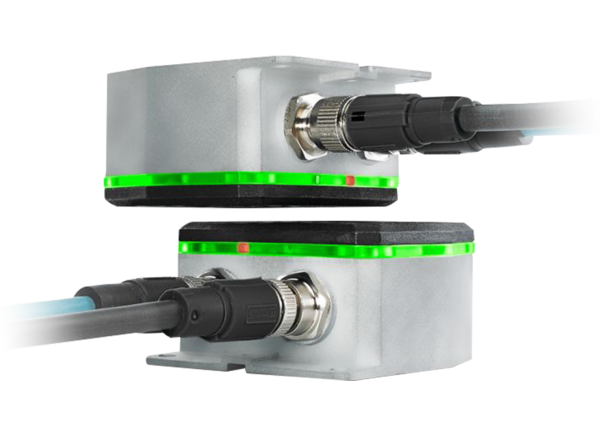
Figure 3: Phoenix Contact NearFi Couplers enable contactless, real-time Ethernet connections and power transmission up to 50W across an air gap of a few centimeters. (Source: Mouser Electronics)
Thanks to NearFi technology, these couplers deliver protocol-independent, near-latency-free, and full-duplex Ethernet data at speeds up to 100Mbps. Because these couplers work with all industrial Ethernet protocols, including EtherNet/IP, PROFINET (Process Field Net), Modbus, and EtherCAT, they can be dropped into existing network architectures without requiring a protocol change.
The couplers’ seamless operation makes them a flexible option for today’s networks and future-ready for advancements like time-sensitive networking (TSN) and OPC UA, which together enable deterministic, real-time communication for modern automation and industrial Internet of Things (IIoT) systems. Unlike NFC and other radio-based technologies that rely on packet-oriented transmission, NearFi uses a synchronous, bit-oriented method for real-time contactless communication, achieving virtually zero latency—around one microsecond, to be precise—making it faster than 5G and second only to a physical wire.
For data-only communication, the signal can be transmitted across an air gap of up to 40mm. When power and data are sent together, the gap typically can be up to 12mm. Because the transfer is fully contactless, there are no brushes, slip contacts, or connectors to wear out during tool changes, rotary indexing, or other continuous-motion operations.
NearFi couplers behave as plug-and-play devices that don't require special programming or network configuration. Their IP65/IK06-rated housings support operation in harsh industrial environments, including those exposed to vibration, dust, and contaminants.
With power delivery, data transmission, and mechanical durability integrated into a single contactless platform, NearFi technology is engineered for automation systems where motion and reliability requirements exceed the capabilities of cabled or mechanically coupled solutions.
NearFi in Action
Each of the motion-based automation systems discussed earlier, rotary tables and workpiece carriers, help demonstrate NearFi’s effectiveness in motion-intensive automation systems.
Rotary Tables
Rotary tables index parts through different stations. For example, in laser welding machines, the table may rotate a workpiece through alignment, testing, and welding steps (Figure 4).[1] At each station, sensors monitor machine states and workpiece positioning, with data collected through a PROFINET I/O module and communicated back to the controller.
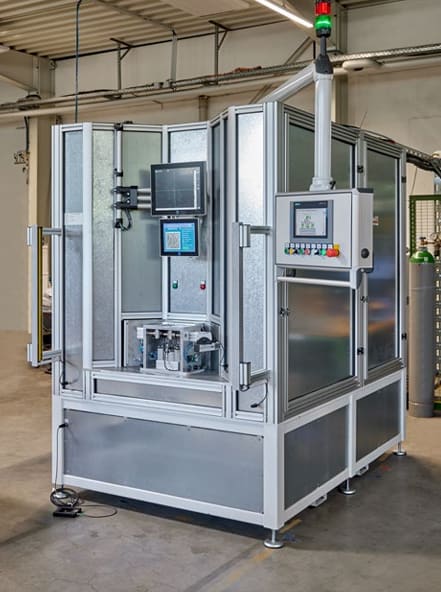
Figure 4: Laser welding machines utilize rotary tables to accurately position workpieces throughout production steps. (Source: Phoenix Contact)
In setups like this, both electrical power and PROFINET data must be transmitted to the rotating platform. Traditional wired connections are prone to cable fatigue, and connectors can loosen or fail under repeated motion. Slip ring alternatives introduce mechanical wear and may cause interference during Ethernet transmission.
With NearFi, a coupler pair can be installed to supply contactless power to the onboard PROFINET I/O modules and to transmit Ethernet data across a small air gap with no latency or wear. This eliminates the failure points associated with mechanical connectors and ensures continuous, real-time communication throughout the rotary cycle.
Workpiece Carrier Application
Workpiece carriers are commonly used in automation environments to transport components through multiple production or testing stations along a conveyor system. In many cases, the workpiece is processed or tested directly on the carrier, with sensors, actuators, and clamping mechanisms controlled via a PROFINET I/O module mounted on the moving unit.
In automated end-of-line test bed systems, which are used to perform leak testing or functional validation, each carrier repeatedly docks at multiple stations where data is exchanged in real time with the controller. Traditional connector-based solutions are prone to wear and signal interference after frequent docking and exposure to fluids during testing. Some systems have moved to WLAN-based communication, but as more wireless networks are added within a plant, interference and communication dropouts can lead to downtime and maintenance issues.
With NearFi, a coupler can be mounted on each carrier and paired with a corresponding unit at each test station to provide contactless Ethernet transmission across an air gap (Figure 5).[2] In this setup, the NearFi link supports real-time communication without mechanical wear, ensuring reliable data transfer for sensor feedback and actuator control throughout continuous docking cycles.
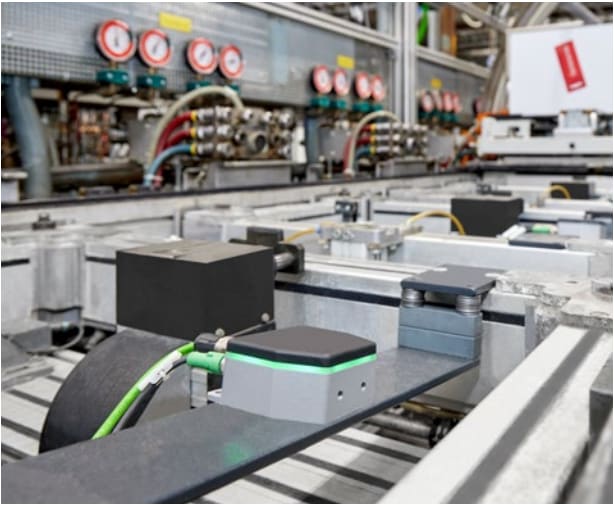
Figure 5: A NearFi coupler for contactless data transmission installed on each workpiece carrier enhances power and data reliability at each station. (Source: Phoenix Contact)
Conclusion
Automation systems that rotate continuously or dock repeatedly force engineers to face two problems: getting power to moving parts and keeping data flowing in real time. Cables can wear out or break from constant movement and slip rings need regular maintenance and may introduce electrical noise. Wireless methods like WLAN or Wi-Fi are sometimes used, but don't always provide the consistent, low-latency response needed for time-critical control.
Phoenix Contact's NearFi couplers move power and Ethernet data across a short air gap, removing the wear points found in wired or slip ring setups. This technology keeps latency low and works with all Ethernet protocols, making it well-suited for continuous motion systems.
Sources
[1]https://assets.phoenixcontact.com/file/4e1b744c-134c-46f9-a1b1-58ca3c29ce28/media/original?EN_NearFi_Use_Case_Rundtakttische_LoRes.pdf
[2]https://assets.phoenixcontact.com/file/d79b8a73-83ed-4b03-8a07-d20be95b40b5/media/original?EN_NearFi_Use_Case_Werkstuecktraeger_LoRes.pdf
Author
 Mat Dirjish is currently a contributing writer for Automation World Magazine covering all aspects of industrial automation from artificial intelligence (AI) to digital twins and cybersecurity. He is also an author/editor for GrowthPoint Inc., creating whitepapers and executive summaries for companies such as Siemens and others.
Previously, Mat was a blogger for IEEE SA, covering the organizations latest standards; Executive Editor & Director of Content for Sensors Magazine & Expo (now called Sensors Converge); Tech Editor for Electronic Design Magazine, covering passive and active components; Associate Editor for EE Product news; and Associate Editor for Electronic Products Magazine, covering test-and-measurement instruments and systems plus embedded systems, computer boards, and software.
Before embarking on a career in tech media, Mat worked for private companies as a designer of high-end audio/video systems. He also serviced these systems down to the component level.